What do we expect of Freemasonry today?
“The Future of Freemasonry: Crisis or Renewal”
CIGLU is the acronym of the International Confederation of the United Grand Lodges (in French, Confédération internationale des Grandes Loges Unies – CIGLU; in English, International Confederation of the United Grand Lodges – ICUGL). CIGLU serves as a platform for mutual recognition, co-operation and fellowship among independent Grand Lodges from a range of countries. The Lodges belonging to this confederation work exclusively in the Ancient and Accepted Scottish Rite. At its gathering in Cluj-Napoca, Romania, from 15 to 17 May 2026, the Worshipful Master of the Research Lodge Maksimilijan Vrhovec delivered a lecture entitled What do we expect of Freemasonry today?
Causes of the crisis and a diagnosis of the present state
To question and debate the present and the future of any organisation – and particularly one with a tradition stretching back more than three centuries – is no sign of weakness. On the contrary, it is an argument in favour of renewal, for an institution that is dying does not debate its own rebirth.
Expansion proved a trap. The surge in membership during the 20th century filled the Lodges with large numbers of inactive members, and quantity prevailed over quality. The philosophical and initiatic work that lies at the very heart of Freemasonry slipped into the background in many Lodges, and no firm core of committed members was ever formed. The social role of Freemasonry changed too, as some of its former functions were taken up by other organisations. This in turn led to a decline in the participation of intellectuals in European Freemasonry – the Fraternity ceased to be attractive as an intellectual forum because it was increasingly reduced to ceremonial ritual without substance and to charitable activity without philosophical depth.
Schisms within the Craft have undoubtedly played their part in the crisis as well – which is a paradox in itself. If Freemasonry was once able to bring together Catholics and Protestants, monarchists and republicans, men of different estates, cultures and world-views, how are we to explain that Freemasonry itself is today so deeply divided?
And so we arrive at an almost absurd situation: everyone lays claim to Freemasonry, yet no one can agree on who is entitled to the name. The crucial question here is who is actually doing the work of a Mason: working the rough ashlar of his own nature.
Besides the internal causes there are, of course, external ones that have contributed to the crisis. One is the conflict with the Church, in whose view Freemasonry and Christianity are incompatible; this has given the Craft a negative image and driven some people away from it. Throughout history politics has often regarded Freemasonry as dangerous – and for many politicians nothing has changed to this day. Conspiracy theorists, for whom Freemasonry is the kernel of a global evil, add their share. For all that, in many countries the public image of Freemasonry is not a negative one. The lack of interest has more to do with Freemasonry being neither mysterious enough to be exciting nor open enough to be understood. In Croatia, regrettably, a good part of the public still holds a negative opinion, which naturally makes our work harder and also affects our ability to attract new members.
The present problems of Freemasonry
Freemasonry often speaks the language of past greatness, but the man of today does not ask only what it meant in the 18th century. He asks: what does it mean to me, now? In other words, it is not clear what Freemasonry has to offer the modern man. The danger to Freemasonry is not the loss of its former power, but the turning of that former power into a myth that takes the place of present work.
The Templars, Freemasonry and myth
One of the avenues of renewal for Freemasonry is precisely a return to the symbols, to ritual seriousness, to the old texts, to the history of the builders’ guilds, to the Enlightenment, to moral pedagogy and to serious study. This is a sound and legitimate foundation, and one worth supporting.
It is not difficult to notice, among a section of today’s membership, something approaching an obsession with the Templars and a romantic idolisation of chivalry and myth. The problem is not that Templar symbols are studied – myth has pedagogical and symbolic power. But one must know the difference between a myth that teaches and a myth that deceives.
Digitalisation
On the other side stands modernisation. Digital tools, artificial intelligence and virtual meetings can be useful. But Freemasonry is an experience of space, rhythm, silence, the glance, the gesture, the body, the symbol, of shared discipline and shared time. Digital tools cannot replace that. Artificial intelligence poses a particular problem – in Freemasonry it is a tool that lays bare the crisis of learning.
Once, the difficulty was how to encourage someone to write two pages. Today, the difficulty is how to stop him submitting ten pages that he did not write himself, from his own experience and observation, but which AI wrote for him. Masonic work must not be the mere production of text; it must be a process of working towards the perfecting of a man. AI is a very useful tool and can be of great help in researching, structuring and comparing sources. But it cannot walk a man’s path in his stead. It cannot keep silence in his place, nor doubt, nor admit weakness, nor subdue the ego, nor confront himself. And that is precisely what we ought to learn and live through in the Fraternity. Artificial intelligence can write an excellent Masonic paper, but it cannot work a man’s ashlar for him.
Another direct effect of the new technologies is the crisis of attention, especially among the younger membership. In the work of our Lodges in Croatia we too encounter questions about the length of ritual work and of lectures. That is a symptom. If a man can no longer follow a line of thought after 20 minutes or half an hour, if every more complex sentence becomes “boring”, if depth is felt as a burden, then Freemasonry is directly affected.
For Freemasonry rests upon the very opposite: upon slowness, repetition, memory, symbolic interpretation, listening, silence and maturing. It is not a short-form format. Quite the reverse – it is a space of resistance to the culture of endless scrolling in search of brief and exciting content. Not in order to be old-fashioned, but in order to preserve the faculties without which there is no serious man: attention, patience, concentration, humility before the text, and the courage to say that one does not know something, or does not understand it at once.
Ego, narcissism and “cancel” culture
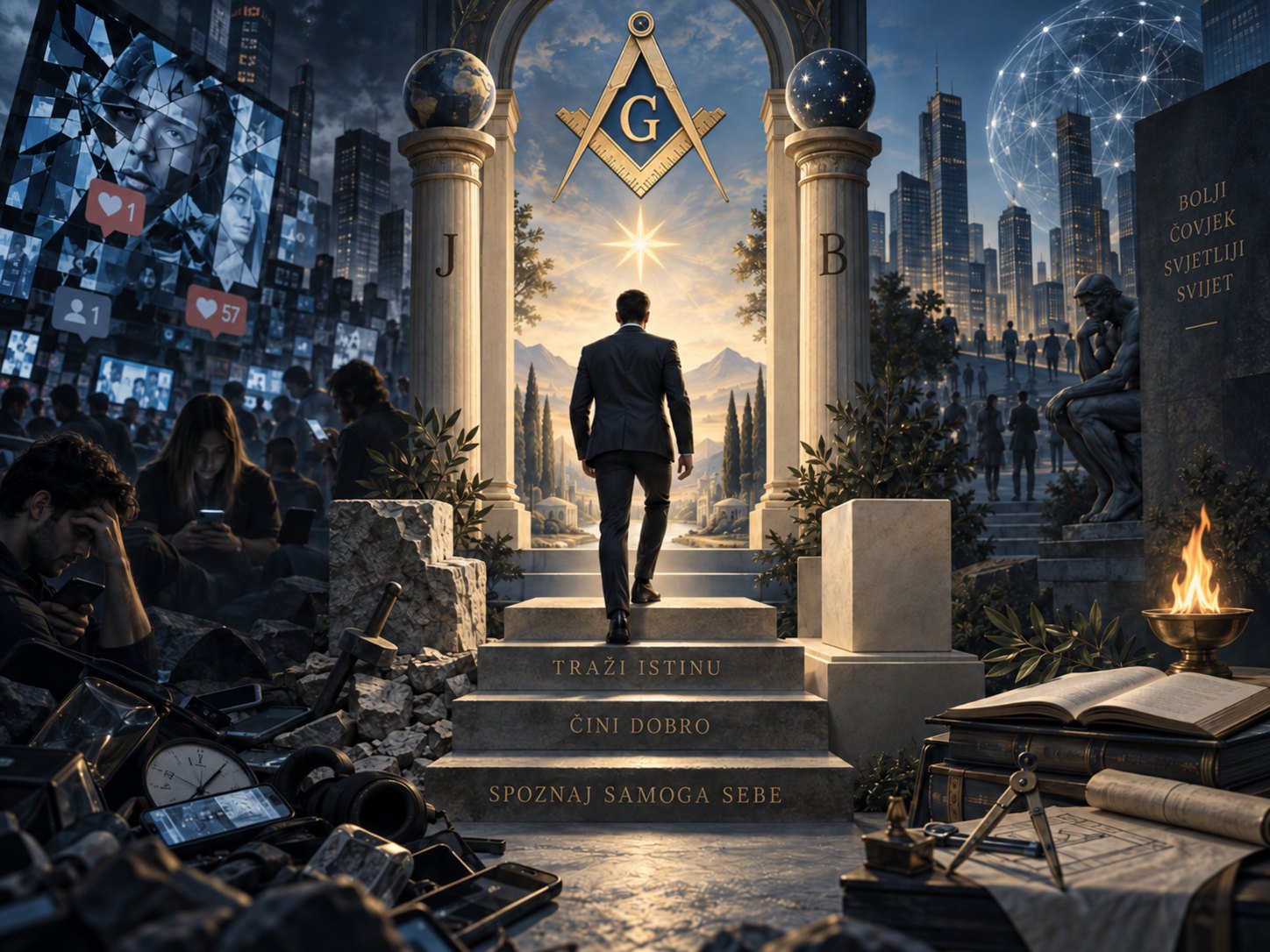
Social media have created a new psychology of public space. Everyone has his own virtual wall, his own audience, his own validations, his own blocks, his own little rituals of approval. Whoever disagrees can be removed, “cancelled” and declared an enemy.
This is the direct opposite of Masonic teaching. Freemasonry, at least in its serious form, ought to be a space in which a man quietens his ego. It is not a place where I am always right, but a place where I can bear the question: what if I am not? In a culture in which everyone curates his own image, Freemasonry must bring man back to the one thing no filter can touch up: character.
Algorithmic conflict and the breakdown of brotherhood
The algorithms of social media reward not wisdom but reaction, conflict and the swift moral condemnation that will spread the conflict further. Emotions such as fear, anger and resentment greatly increase the likelihood that content will be shared and go on spreading. This does not mean that people have become worse in their essence. But it does mean that every day they move within systems that draw out the worst parts of their nature. Here too Freemasonry can be of great help, teaching its Brethren moderation, reflection and, most important of all, responsibility.
Social media create the semblance of community, yet they often produce emotional exhaustion, conflict and, in consequence, withdrawal. People are virtually connected but existentially alone, and this can have serious consequences for the health of the individual and of the community alike.
Here too Freemasonry can play a real part – through real, physical meetings, through the encouragement of responsibility, through teaching the value of silence and the value of listening and of conversation with Brethren who understand you and whose attention you have. In a world of virtual connection and real solitude, the Lodge can once again become a place where a man is not a profile but a Brother. And that has always had, has now, and always will have an exceptional value in the life of every man.
The experience economy
We live today in an “economy of experiences rather than an economy of living”. Almost anything can now be manufactured: the picture of an event, a journey, the semblance of knowledge, an artificial voice, a forged document, an emotional post, even an entire false memory. This alters our relationship with truth. If everything can be simulated, then authenticity becomes one of the most endangered of values.
Freemasonry is a space of unsimulated experience. Not because everything in it is perfect, but because it demands presence, time, repetition, responsibility and encounter with other people who are not obliged always to affirm us. But this holds true only so long as Freemasonry does not itself turn into stage scenery. If the symbols are used merely as décor and the ritual is performed without inner meaning, then Freemasonry too becomes part of the experience economy. The question is not whether Freemasonry can survive digitalisation, but whether it can remain real in a world that turns everything into a performance.
The tyranny of positive psychology
Today’s culture frequently does not permit a man to be whole and to have real emotions, including sadness, tears, anger… He must be positive, productive, motivated, grateful, successful, emotionally regulated, perpetually “fine”. He is no longer even allowed to call his own states by their proper names. A problem must not be called a problem; it must be called a challenge. Failure must be a “lesson”. Grief must swiftly become “growth”. Breakdown or burnout must be a “new opportunity”. Positive thinking has its value, of course. But when it becomes a command it ceases to be a strength and becomes a form of violence. When a man has no right to sadness, doubt, anger, weakness, remorse and emptiness, he loses the possibility of genuine self-knowledge.
The first work in Freemasonry begins with the working of the rough ashlar – because it has cracks, irregularities and hardness. That is precisely why it is worked. Freemasonry must not be a culture of compulsory positivity. It must be a space in which a man may admit that he is unhewn — for only then can the work begin.
Reforms
Many have turned their minds to the present and future of Freemasonry. The proposed reforms may be grouped under three headings.
The school of conservative optimism — the Fraternity has survived monarchies, Nazism, fascism, communism and its conflict with the Church. The fall in membership is a statistical anomaly, not a structural collapse. What is needed is patience and fidelity to the foundations.
The school of reformist realism — authors such as Hammer, West and Poll, and those who think as they do, argue that the Fraternity must radically improve the experience within the Lodges. What it is need not change — what must change is how it is transmitted and lived. They treat Freemasonry as “a philosophical society that demands of its members the highest standards in every aspect of its work”. Such Lodges do not suffer from falling membership — on the contrary, they have waiting lists for initiation.
The school of structural transformation — some European voices call for a move towards a federal mode of operation among Obediences, the development of international Masonic think tanks, greater transparency and an opening towards a wider dialogue with society.
The present and future of Freemasonry
Several possible scenarios lie before us, of which two are the most likely. The crisis scenario holds that Freemasonry may continue to decline if the Lodges remain captive to the past – to a former, almost mythical, historical importance. The membership grows old; the young seldom come and soon leave; the ritual is performed with technical correctness but without understanding; education is an afterthought; conviviality becomes more important than work. In this scenario Freemasonry does not vanish at once, but turns into a memorial society to its own history.
The renewal scenario starts from the premise that the crisis is a summons to return to essentials. It looks like this: fewer but better Lodges; a more rigorous admission of candidates; better mentoring; a deeper interpretation of the symbols; ritual as a school rather than a show; clear public communication; ethical service to the community; a greater role for the young, but without trivialising the tradition; the Fraternity as a real discipline and not merely an emotive word.
In this scenario Freemasonry does not attempt to be a mass movement, but an élite in the ethical rather than the social sense: a community of those who wish to work seriously upon themselves.
The common minimum: work on oneself as the centre of all our differences
If there is anything that ought to be common to all Freemasons — regular and liberal, believers and non-believers, conservatives and progressives, male, female and mixed Obediences — it is work on oneself. The conviction that man is not a finished thing; that he must educate himself, perfect himself, chisel, learn, examine himself and answer morally for who he is.
Freemasonry is a path of self-knowledge and of the moral perfecting of man through symbol, ritual, brotherhood, learning and service. The definition that ought to outlive every schism is this:
Know thyself.
Self-knowledge is not an introspective ornament, nor “working on oneself” in the shallow, motivational sense. Nor is it a collection of psychological catchphrases, nor a narcissistic preoccupation with oneself. The modern man lives through roles and masks: the role of parent, political allegiance, national identity, religious affiliation, social status, profession and position within an organisation.
Self-knowledge is a painful process; it parts a man from his roles and his masks. That is why the question — who are you, truly, when you strip away all your roles, your titles, your masks? — is so very hard. The silence that then falls is not weakness. It is the beginning. For most people realise for the first time that they do not know the answer. And not knowing the answer to that question may be the first honest moment of self-knowledge. For self-knowledge does not begin with an answer to the question “who am I?”, but with the unease that arises when I realise that all my life I have been answering only for my roles, and never for myself.
If the future of Freemasonry lies in self-knowledge, then the Lodge must become a workshop of man. The Lodge of the future will not be the one with the most members, but the one in which a man dares to be less false.
Freemasonry is indeed in crisis if it is measured by its former influence, by numbers, by social power and by the myth of its own historical importance. It is in crisis, too, if it splits into camps that refuse to recognise one another, or if it takes refuge in myths or in digital shallowness. Yet the modern world produces the very things for which Freemasonry may hold the remedy: distraction, loneliness, ego, superficiality, conflict, the loss of real conversation, the substitution of roles for identity, of experience for living, and of a positive façade for the truth about man.
Freemasonry has no future if it wishes to be as powerful as it once was. It has a future if it once again becomes necessary – if it offers man what the modern world systematically destroys: attention, silence, brotherhood, self-knowledge, measure, responsibility, learning and work on oneself.
Freemasonry once took part in shaping modern society. Today its task may be harder still: to help man survive the consequences of that modern society without losing himself – and, instead, to find the man within.
May 6026 A∴L∴
Worshipful Master of the Research Lodge “Maksimilijan Vrhovec”, Brother M.F.
GRAND REGULAR LODGE OF CROATIA